Misse–Muar patronage
Systema Delenda EstMisse–Muar patronage is a relationship of calculated elevation rather than simple affection. Misse Eln gives Muar the visibility, authority, and institutional backing of Clan Eln, presenting a former Sydean mortal as the System’s Blessed Crusader and placing him at the center of the campaign against Cato. In return, Muar offers devotion, insight, and a rapidly expanding political base. Misse treats him both as a weapon for the present crisis and as a future power capable of preserving the System and, in her broader formulation, reality itself.
Origins and Unequal Status
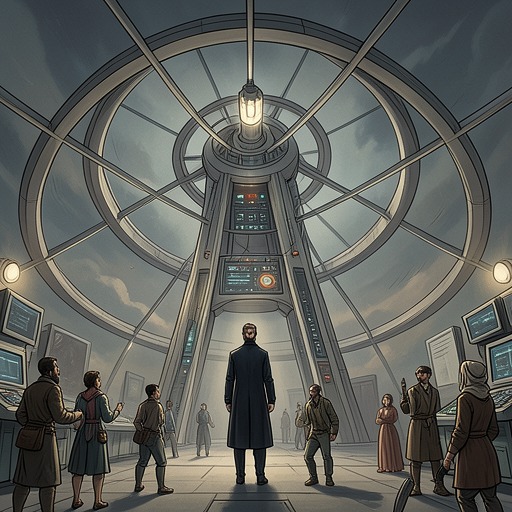
Muar’s position within Clan Eln begins as a startling breach of established divine hierarchy. When Misse brings him into the gathering of Clan Eln deities, he is still a mortal, and his Sydean origin makes his presence especially offensive to many of the gods. His rise, however, is impossible to dismiss: he has advanced from nothing to Azoth in twenty years, a meteoric ascent that suggests he may reach Alum within another century and then make the second ascent into godhood. Misse’s patronage converts that possibility into a political expectation. Under her protection, his origin ceases to be treated as a disqualification, because the System appears to have blessed him and because he has accepted Clan Eln’s sponsorship. Muar’s favored position makes the hierarchy visible. At Misse’s meeting, he stands at her right hand, the place of honor that many established gods believe should belong to a member of the Clan rather than to an “up-jumped mortal from a backwater race.” Their resentment remains silent because Misse’s favor gives Muar protection, while Muar’s value as a rising star makes open opposition dangerous. Muar himself understands the danger of overplaying that privilege: he remains standing rather than sitting among the gods, acknowledging the difference in status and avoiding needless enemies. The arrangement therefore advances him while never allowing him to forget that his access depends on Misse’s authority.
The Crusader as Clan Instrument
Misse’s patronage becomes operational through the Crusade. She appoints Muar as the Blessed figure among the mortal worlds, charged with ensuring that Planetary Administrators and temples coordinate their response to the foreign threat. The assignment gives Muar influence far beyond what his mortal status would ordinarily permit. He can pressure worlds, direct attention toward the campaign against Cato, and, where Misse authorizes it, distribute divine gifts that allow Azoth-rank and higher mortals to fight the enemy. The power is deliberately double-edged. Muar’s public role appears to be religious leadership and defense, but Marus recognizes that Misse is also using him to extend Clan Eln’s reach. His authority over the Crusade becomes leverage against worlds and against gods reluctant to commit themselves. Misse’s policy is correspondingly expansive and coercive: worlds are to be audited, including those belonging to other Clans; compromised worlds may be condemned; and stronger measures may be taken than would normally be acceptable. Muar is the visible executor of that policy, the favored mortal whose legitimacy makes Clan Eln’s intervention appear like a System-sanctioned necessity. Misse’s support also compensates for the limits of Muar’s office. Muar admits that, despite his title and achievements, he remains mortal and doubts that the other gods will listen to him. Misse agrees that they will not, but explains that persuasion is not the reason she chose him. She selected him for insight and commitment. His authority is therefore not founded on conventional institutional rank; it is founded on delegated trust, divine favor, and the threat that stands behind both.
Mentorship and Future Ascension
The relationship changes when Misse teaches Muar to see beyond the immediate Crusade. She tells him that being Chosen serves purposes other than bringing wisdom to fools: she values his insight and commitment, expects his mortal status to be temporary, and urges him to consider what he will do after he is no longer a Crusader. Her intervention lifts Muar out of a consuming fixation on Cato. He begins to understand the crisis as a test and himself as more than a disposable instrument. That shift produces a political imagination. Muar’s friends and fellow Crusaders already form the seed of a faction loyal to him. If he leads that faction, he can accelerate his path toward Alum and possess a useful power base should he attain godhood. Misse’s patronage thus does not merely protect an individual; it helps manufacture a future political actor. Her mentorship teaches him that rank, piety, and direct communion with the System are insufficient by themselves. Power must be organized through cooperation, factions, and Clans. Muar responds by embracing Misse’s larger view. He comes to regard her as the most praiseworthy of the gods because she understands the danger Cato poses and acts without hesitation or dissembling against those insufficiently committed to the cause. He also admires that the Crusade is not her only concern. Unlike gods content to squat on their assigned worlds, Misse maintains interests across the Inner Worlds and looks beyond routine planetary administration. Muar imagines eventually walking beside her with the preservation of reality as a shared goal.
Patronage, Belief, and Political Calculation
Muar’s devotion is strengthened by his religious experience before he becomes Misse’s favored agent. On Uriva, after passing through a temple and feeling the System’s presence restore him from the horror of System-less existence, he meditates for days before the System crystal and receives the Divine Insight Skill. The experience confirms for him that the System offers truth, progress, purpose, and meaning. Misse’s patronage therefore finds a receptive believer: she is not merely offering secular advancement to an opportunist, but giving institutional form to the faith that structures his understanding of existence. Yet the relationship is not reducible to shared theology. Misse understands that many gods mistake power or piety for adequacy, while Muar recognizes the same weakness among his peers and among people he knew on Sydea. Their conversations turn religious commitment into an organizational doctrine. Parties and Clans teach that cooperation yields more than solitary effort, and Misse defines the decisive distinction as the difference between those who wield power and those who are wielded. Muar wants to be among the former, but his own position remains deliberately ambiguous: he is empowered by Misse precisely because he can become useful on a scale larger than the office he currently holds. The patronage also exposes an asymmetry of information. Misse sees Muar as a tool whose utility may develop into independent power; Muar understands that he is being used, but interprets that use as part of a divine design. He suspects that Misse is leveraging him against other worlds, yet he does not reject the role. Instead, he reads the opportunity as evidence that the System has greater purposes for someone worthy. His faith converts political dependence into vocation, while Misse’s calculation converts vocation into an instrument of expansion.
Limits and Consequences
Misse’s support does not make Muar equal to the gods around him. At meetings he lacks a World Deity’s authority over the complex mechanisms of planetary administration, and he can understand only portions of the technical plans being discussed. His strength lies elsewhere: he observes who is confident, hesitant, evasive, or bluffing, and he translates institutional behavior into political knowledge. Misse uses that intelligence to decide when cooperation has ended and coercion must begin. When Misse announces that Clan Eln will soon move against the first independent gods, Muar welcomes the prospect of entering the final stages of the Crusade. The exchange marks the point at which his delegated authority becomes an instrument of internal consolidation. Independent worlds are no longer merely potential allies in a campaign against Cato; their refusal becomes evidence of sympathy with the enemy. Muar’s mace at his side makes his readiness physical, but the real force behind him is Misse’s decision to turn his title into a mechanism for testing loyalties. The relationship’s final significance lies in this fusion of protection and exploitation. Misse gives Muar legitimacy that his birth, species, and mortal condition would otherwise deny him, while Muar gives Misse a mobile, rising representative who can act across the mortal worlds. She treats him as a future god before he has become one; he treats her as the mentor who has revealed the scale of his destiny. Their patronage consequently binds personal ambition to institutional violence: Muar’s ascent, the expansion of his faction, the enforcement of the Crusade, and the pressure placed upon independent worlds all proceed through the same relationship.